Thursday, May 24, 2007

Adventures in Podcasting Part One

Time4 Online Conference

The Time4 Online NZ virtual conference runs from 28th May to the 8th June, 2007. I will be presenting on Podcasting in the Online Publishing With Audio and Visual Tools section of the programme. This is part one of my presentation looking at the importance of Oral Language instruction in the classroom and some of the research around this. The presentation also gives a general outline of what podcasting is.

Links referred to in this podcast are:

TKI - Assessment: Exemplars: English: Oral Language

Special Delivery 1: What is Podcasting? | Ask A Ninja

MCM Report FINAL.qxd


technorati tags:,

Blogged with Flock

Tuesday, May 22, 2007

Who's been sitting in my chair?

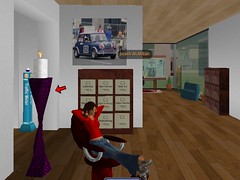
Last night I went on a walk through Second Life (see my last post) and spent some time looking around David Warlick's office but I made a little mistake. I sat down on a comfortable looking chair in his office...

Well, I got distracted in RL, so I clicked to quit out of SL. The next morning I realised I hadn't left David's office before quitting. I quickly logged in to get out of the chair and walk outside and who should be standing in front of me but a confused David. I apologised for being in his office and he told me that he hadn't noticed me come in (which I hadn't as I had just appeared). We then proceeded to have an interesting albeit brief conversation about the glass walls in SL and learning how to live in a world without secrets or locks.

It is quite difficult constructing a code of conduct for a new world. This makes me think of our students walking into our schools and classrooms. For many of these students it is a new world with new rules that they neither know nor understand.

technorati tags:,

Blogged with Flock

Monday, May 21, 2007

Wandering around in Second LIfe

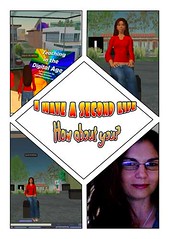
Well, It is strange this new world!  But I am really enjoying it :-).  I have just taken a walk around Steve Dembo's office in Second Life and then ambled over to Will Richardson and David Warlick's offices.  While in David's office I took a look through his filing cabinets and read some of the files he has there.

It is a strange new world.  For these educators it is past 2am in the morning, for me it is 7:30 at night and I'm walking through their offices.  There is a whole new etiquette to learn.  Is it okay to walk into people's houses?  Is this a new type of society where everything is open and nothing is private?  No one has any secrets and there is no way to steal or vandalise or otherwise upset the utopia that is EduIsland? 

I have already had many conversations with Educators in Second Life that have been stimulating and enlightening.  It is like IM on steroids :-).  There is something more personal about talking to someone when they have a body and a sense of style.  I have started a lot of conversations with, "I like that dress, where did you get it?" :-).  It is really exciting seeing where this Web 2 is taking us, whatever next?

technorati tags:, , , , ,

Blogged with Flock

Levelator

I have found a new tool for podcasting (audio only) which I tried out and it works really well.  It is called the levelator.

The Levelator 1.1.0 Screen Shot

GigaVox Media, Inc. » The Levelator™

This tool is a free download for both Mac and PC.  What it does is it levels out the volume of voices on the podcast, so if you have two or more people speaking on the podcast it will match their volumes.  (I just love the name!!!  Hi, I'm the levelator {spoken with Arnold Swartzenegger's voice}).  It works on aiff and wav files and it is just a matter of dragging your file onto the application and it does all the work for you.  Pretty cool. 

technorati tags:,

Blogged with Flock

Wednesday, May 16, 2007

10 Years to save the planet

Our cluster will be embarking on a cross cluster inquiry next term and the topic is "10 Years to Save the Planet".  This is based on an article we read in the Otago Daily Times on global warming and the pressures the Earth is facing.  Reading Derek's Blog today, I came across this:Zerofootprint: Footprint Calculator

I went through the questions to see what sort of damage my lifestyle was doing to our planet and it was a bit of an eye opener.  We take it all for granted and this is a good way to show the students in our classes that there are things we can do to make it better for everyone.  Unfortunately NZ isn't one of the countries listed but you can compare your footprint to the Average Australian as our closest neighbour.

technorati tags:, , ,

Blogged with Flock

Saturday, May 12, 2007

2007 Web2 Awards


Read this on Derek's Blog today. If you are interested in Web 2 technologies and want to see what is out there, this is a great site to get started with (click on the image to go to the site). There are over 200 Web 2 tools put into 41 categories. The growth of Web 2 truly is amazing. I began looking at this stuff just over a year ago, made a podcast, put together a wiki and a blog page, thought I was doing well. Now there is just way too much to choose from to not be using this in your classrooms!

Thursday, May 10, 2007

Hero in the Hallway!

I found this video on the Cool Cat Teacher blog. She stated that it gave her goosebumps, it made me want to cry. If you are coping with bullying in your classroom or teaching about bullying prevention, this would be a great discussion and action starter.

South Park Mac vs. PC

I'm not normally a watcher of South Park but I couldn't resist this clip. This is for Vicki who thinks I am too much of a Mac Freak.
(There is nothing offensive in this clip)

Tuesday, May 08, 2007

Graffiti Creator

I was just reading Naketa's Blog and found this:

GraffittiCreator.png

I came across this really cool website Graffiti Creator yesterday while I was designing t-shirts for a friend of mine. My usual awesome t-shirt designer was busy so I had to track down some way of creating a cool Graffiti logo. Graffiti Creator lets you play with a template (you type your own word) and add effects and colour! What a cool online tool!

I immediately had to have a play.  I have a group of yr 6 boys who would think this tool was the best thing ever!  I can see when I show it to them that I will have this as the main heading for all of their presentation work instead of the boring word art I seem to get all the time now!  Thanks Naketa.

technorati tags:,

Blogged with Flock

Will you be a hero in the hallway?

Steve Dembo has a video on his blog about bullying prevention called Will you be a hero in the hallway. This is a powerful video. If you have problems with bullying in your school or want a good discussion and action starter for a unit on bullying in your classroom then this is the video for you. The Cool Cat Teacher blog said it gave her goosebumps, well, it made me want to cry. This is a powerful video and demonstrates the power of giving students voice. Check it out. (For some reason I couldn't embed the You Tube video on my blog today so head over to Steve's blog to see the video)

Friday, May 04, 2007

Gosh Mum, go look it up on the internet!

Gotta share this.

Tonight I was watching "Happy Feet" with my kids.  I realised that it was a story about a society that valued singing and a society that valued dancing.  I paused the video and asked my 14 year old son what his society valued.  He cried at me in an exasperated voice, "Gosh mum, go look it up on the internet.".  Gee, I have to talk to my son via the internet now.

mmmmm.

technorati tags:

Blogged with Flock

Saturday, April 28, 2007

My Favourite Professional Development Podcasts

I have just posted my latest podcast episode which is a review of some of my favourite professional development podcasts that I am listening to at the moment.

This review includes:

All of these podcasts originate in the US or Canada and I am asking that if you know any good podcasts that come out of Australia, NZ, UK or other parts of the world, please leave me a comment. There are too many podcasts out there to listen to them all, but if we share the gems we find, it will make the process much easier. Let's share our knowledge and save our time!

You can listen to my podcast at the ICT U Can! Podcast page.

technorati tags:, , , , , , , , ,

Blogged with Flock

Monday, April 23, 2007

Potter Puppet Pals in "The Mysterious Ticking Noise"

This is just so funny!!!

Saturday, April 21, 2007

Club Penguin


Today I have had the interesting experience of watching my daughter play club penguin.  She is new to the environment so I got to experience this virtual world through her eyes.  In her words, "I think it's awesome cause it's fun and you can meet new friends."

Club Penguin is a safe environment for young children to try out a virtual world.  They take on the form of a penguin and are told to give it a fictitious name.  The site is great for showing kids the safe way to be on the net.  They then get to wander around the environment and interact with other penguins.  They can talk to each other and this is made easier for younger children by the fact that they can choose phrases already loaded onto the computer rather than trying to type it out by themselves.  Questions are available for them to click on such as:

  • "What is your favourite animal?
  • What is your favourite game?
  • What is your favourite sport?
  • What is your favourite movie? music, TV show?
  • What are your hobbies?

There are also affirmations you can send to people when you are playing with them such as "Good game!" "Good move!".  Also there are some phrases to click on if someone is annoying them.

This is a great environment.  The kids get their own igloo which they can start to decorate if they become paying members of the site.  They can invite their friends back to their place and have a party.  To get money in the game to use the penguins go to different places to do some 'work'.  This work involves playing games such as building pizzas, round up puffles (pets that the penguins can own), and go ice fishing.

But the icing on the cake for me was listening to my daughter exclaim, "I've got so many friends!"  She invited everyone she passed to be her friend and was excited every time someone said yes.  What a great environment!  This is a very positive site, full of games and affirmation and not a sad face in sight.  Wish I lived in Club Penguin :-)

technorati tags:, ,

Blogged with Flock

Wednesday, April 18, 2007

It's a New World

I have been following the Virginia Tech shootings with horror. It is a terrible situation and how it continues to be allowed to happen in the US I do not know. My heart is with the people who are suffering through this time and also with those who have already suffered through similar tragedies.

The reason for this post, though, is to take a dispassionate look at the change that Web 2 has made in light of this tragedy.

Firstly, after hearing a brief report on the radio in NZ of the shooting I 'googled' for more news. I came across the Wikipedia page. I have been watching this page with fascination. The page is constantly evolving as more information comes to light, but what is even more interesting is to read the discussion tab on the page. This is where you can read the collaboration going on by the myriad of authors contributing from around the globe. People are discussing ethics, separating fact from fiction from emotion, discussing the correct terminolgy to use - is this a massacre or a shooting? Should the killer be included among the number dead or reported separately? There is even a discussion thread about whether the killer should be termed 'Asian' or 'East Asian' (the distinction here being the understanding of authors in America versus authors in England). I have really been amazed by the amount of discussion going on around presenting this information correctly.

I then followed some links to blog sites written by students at Virginia Tech, here and here and a site with more links here. These students were letting their friends and families know they were okay and publishing their experiences and feelings about the tragedy. The amazing thing is that these students found their only link with their family and friends was through their blog or email as all the phone lines were jammed.

The next interesting thing is that the media started searching the Internet for these self written blog reports to track down witnesses prepared to make statements. They contacted these bloggers by leaving comments on their blogs. Some of these comments make your skin crawl, beginning with a we are so sorry this happened to you type of comment followed by a very eager when can we contact you comment. For example:

"Hi, I'm glad you're okay. I understand that peoples phones are notworking too well in all this chaos. Have you and your friends beenIMing, blogging or posting bulletins about what it going on? I work forthe Boston Herald and I'm wondering if online communication is the bestway to stay in touch during a crisis. What do you think?"

The Internet was also instrumental in letting students know what was happening during the shooting. The Wikipedia article reports that Virginia Tech kept students informed via email during the shooting. Students were instructed to stay inside and stay away from the window via email messages.

The title of my post - It's a New World - is referring to the fact that information truly is only a click away. No longer do you have to rely on the media to report sparingly. You can read heart wrenching stories written by those involved. You can let your friends and families know that you are okay through your online journals. But the thing that really hit home for me in a time when people are questioning humanity, is the humanity of the people involved in putting together the wikipedia page.

In this time of fear for the families of those involved I'm sure this diligent and ethical reporting by Wikipedia is greatly valued.


technorati tags:, ,

Blogged with Flock

Monday, April 16, 2007

Podcasting in Primary Classrooms - Straight from the trenches

In my position as an ICT Facilitator and even more so now that I am spending a year researching podcasts in the classroom, I get to listen to a good many different classroom podcasts. I thought that it would be a good idea to present some of these podcasts in a review to help teachers who are wanting to have a go at podcasting have a starting point.

The podcasts that I review in this episode are all primary (elementary) schools:
KPE: http://www.ptengland.school.nz/index.php?family=1,338,788
Small Voices: http://kinderteacher.podomatic.com
Rowland: http://rowland.podomatic.com
Andersen's: http://adonnell.podomatic.com
Cefn Fforest: http://cefnfforest.podomatic.com
Appleby Showcase: http://allanah.podomatic.com
Pine Hill School: http://room5.podomatic.com

If you would like to listen to this podcast, just head over to my podcast page.

Sunday, April 15, 2007

Meme - Simply successful secrets

Well, I have been tagged...


Miguel would like to know ...

List the top 5 to 10 things that you do almost every day that help you to be successful. They can be anything at all, but they have to be things that you do at least 4 or 5 times every week. Anything less than that may be a hobby that helps you out, but we are after the real day in and day out habits that help you to be successful.
Source: Around the Corner v2 - MGuhlin.net, Ed Tech Journeys' Guest Blogger, Sylvia Martinez (GenYES Blog) writing on this meme by Thea Westra, Simply Successful Secrets

mmm...

1.  Wondering

I must admit to being a chronic questioner.  I always want to know why or why not.  I am a volunteer for Habitat for Humanity and I drive my working buddy mad as when he instructs me on my next job, I can't just do what he says, I have to know why we are doing it that way and weigh up in my mind if it is the best way for it to be done (cheeky I know since I have no building qualifications!).  I think this is a good example though because if you are a questioner then you begin to feel that you can solve any problem.  Problems become exciting and you rub your hands together eagerly to face the next one.  This is an environment I strive to create in my classroom.

2.  Problem solving

My next habit leads on from the first.  I not only ask questions but I am tenacious in finding out the answers.  I expect to be able to find out what I want to know when I want to know it.  This is why the idea of 'clickability' that David Warlick mentioned in his keynote in Dunedin really resonated with me.   I laugh at my frustration when I am reading a book and I know that the information I need is in there but I can't just search for it.  A day without internet connection leaves me shaken :-)

3.  Reading

I have a voracious appetite for reading.  I begin my day reading my blogs and entering into the journey through the net they take me on.  I then take a break to read my latest novel to have a moment of escape from reality (currently reading the Red Tent by Anita Diamant).  I am successful in creating a love for reading in my classroom and enjoing many discussions that arise from engaging with text.

4.  Running and reflecting

I find that if I don't run at least three times a week I don't embrace life as vigorously as I could.  Running gives me the time to reflect on everything that is going on in my life and to make sense of it.  I am not a person to meditate or sit still.  I am not a person to take the time to reflect if there is work to be done.  So running allows me the time to take store of my experiences and sort out the world. 

5.  Family Support

Overarching all of these habits is the habit of using my family thermometer.  I can sometimes get carried away with my work.  For me education is not a job it is a passion and a hobby, something I am involved with because it fascinates me.  This means that I can lose myself in it and get lost.  My family grounds me and helps me to stay in the real world.  They celebrate my successes and they commiserate with me when things don't go so well.  They help me to keep going.  So the most important habit for me is to make sure I put my computer away, pack up the books, clear my mind and take some time out with my husband and kids.

Well, that was quite a cathartic experience! 

So 'Tag' you're it -

  1. Greg Carroll
  2. Steve Dembo
  3. Iain Bonney
  4. Lyn Ross

technorati tags:, , , , , ,

Blogged with Flock

Wednesday, April 11, 2007

Teachers paid bonuses for student results!

I was shocked to read this in the Age today...

"In January this year, nearly 8000 teachers working in the US city of Houston, Texas, received bonus cheques from a $US14 million merit pool as part of the district's biggest-ever performance pay scheme. Each teacher was measured against a complex formula that attempted to assess how they helped individual students improve on annual standardised tests. Based on their "performance", some teachers received as much as $US7175 ($A8174); others as little as $US38. Soon after cheques were issued, the name of every teacher who was rewarded a bonus - and exactly how much they received - was published on the website of the city's local paper, the Houston Chronicle."

To read the full report click the link.

Pay as you learn - In Depth - theage.com.au

Imagine the uproar as these teachers' names were published in the paper. Parents clambering over each other to demand that their children be taught by those teachers ranking highly. The shame and condemnation of those teachers scoring poorly. What an education system to be a part of!

But wait... There's more!

After a while you get used to reading these sorts of stories about educators in the US and with a shake of the head and a 'tut tut' you thank your lucky stars it could never happen in your country (insert your country here). Well, I was shocked to read at the bottom of this report that the Federal Education Minister of Australia was entertaining this as a GOOD idea! What???

Thank goodness I moved to New Zealand.

technorati tags:,

Blogged with Flock

Thursday, April 05, 2007

Think before you post

This video is a powerful way to demonstrate to students how important it is to 'think before you post'. The image or content will be shared and available to anyone anywhere at anytime.

Monday, April 02, 2007

Kath Murdoch - Inquiry - Part Two

Firstly let me urge you to take a look at Kath's book "Classroom Connections" which will do much more justice to the Inquiry model than I will do here.

Kath begins today's workshop with a powerful quote:

"If people are given the skills and tools to use, and presented with a range of potentially powerful educative experiences, then given freedom, they will almost invariably choose one and get on with it. Once learners get in touch with their own sense of personal power ... get out of their way and watch in awe" (Edwards, 2004)

This quote made me think of something Sheryl mentioned in her keynote at TUANZ: You need to own it to give it away. You need to see the value in the inquiry process to use it effectively in your classroom. Your students also need to see the value in the process and be familiar with it to use it independently according to their age and stage.

The first focus of the day was on planning. It is a misconception that there is no planning involved in Inquiry, quite the opposite. What I took the most from this section of the day was the importance of including the students in the planning stage in some way and the need to have clarity about what we want our students to understand, to do, and to be.

Planning starts with a big question, eg, "what is a hero?" which is followed by the key understandings that you want your students to have. These need to be demonstrable and are written as statements.

Kath gave a vivid illustration of the inquiry process, she stated that taking students through the understandings in an inquiry is like taking them through a colour shade chart from the pale understandings through to the deeper understandings.

It is really important to spend the time to make sure that your understandings are robust. Do they do what you need them to do? How will you know if your students have achieved these understandings? What skills will your students need? What might your students do with this learning?

Kath shared an idea that really grabbed me when discussing skills. Some teachers that she had worked with had broken down their essential skills into 'kid speak'
  • Me as a thinker,
  • Me as a communicator,
  • Me as an ICT user,
  • Me as a team member,
  • Me as a learner.

This fits really well with the New Zealand Key Competencies. (An excellent paper on unpacking the key competencies is entitled "The nature of the Key competencies" and can be found through the link above.) I will take this idea away and make it fit my school and my context. Something from the inquiry should relate to these skill sets. My thinking is that I would put these headings up around the room and put activities we might use under each one as we learn new tools, for example I might teach mind mapping as a tool and put an example under 'me as a thinker'. Students could create a poster to represent the new tool they have learnt, such as think, pair, share. How much more powerful will that poster be than one bought from a shop! Kids can self assess how they are going with learning these skills through the year. You could keep these on the wall throughout the year building on the skills as you go.

Kath states: "What makes it powerful is sharing it with the kids."

Kids could also create a grid with the headings: Thinking tools, what is it? what is it used for? when is it used? during the year as they learn them. This could also be made as a class book (thanks Esmay).

The next part of the workshop looked at the actual process of Kath's inquiry model. The steps involved are: (for a more comprehensive look at the stages you can see Kath's books 'Classroom Connections' and 'Focus on Inquiry' or visit this website.)
  • Tuning in
  • Finding out
  • Sorting out
  • Going further
  • Concluding, reflecting and acting
Tuning in is about assessing where students are at and enaging them. It is about tuning into the students as well. The wonderings (where students formulate questions) are part of the tuning in but will continue throughout the inquiry.

It is a good idea to ask students their theories during this phase and record them, coming back to them many times during the inquiry and having them see if their theories still fit. This is a good way to see how their thinking is changing throughout the inquiry. Getting kids to demonstrate their understandings before the unit gives you baseline data and can be repeated throughout the unit to look for changes in understandings.

The finding out phase of the inquiry entails students having real experiences, gathering real data and finding out how to find out.

The sorting out phase is where you make sense of the data gathered in the previous phase. Remember this is not a strict linear model, students can find out and sort out all through the inquiry. Students can use the arts to represent understandings, use poetry and language, mind mapping and thinking tools. Think about what did the information tell us, what did it make us wonder. Use reflective thinking tools.

The next phase of the inquiry model, Going Further, is the phase where most junior teachers tell me that it is not possible to do this with their students. Kath exhorts that we must make the commitment to giving kids choice and ownership of their learning. This can be closely negotiated, contracted etc. It doesn't mean giving the kids free range. An example for juniors is to set up learning stations with a contract where they tick off when they have finished the activity and draw a smiley face to show how they felt about it. This starts them off on the journey to being self directed learners. We need to build the skills in students to be able to enter the going further stage.

Guide the students through their going further process by using the same steps in the inquiry. Support them all the way. It doesn't always have to be individual it can be a group of students. The key to making this phase work is organisation!

Lastly, (not really lastly but continually!) students should be drawing conclusions at every phase of the inquiry using reflection strategies, evaluating and re-evaluating their theories, and reviewing both content and the process.

Some reading for further understandings suggested by Kath:

  • Inquiry based learning using everyday objects, Alvarado and Therr
  • Talking their way into science, Karen Gallas, Teachers' College Press:NY, 1995.
  • Reading for meaning, Debbie Miller

Starting with such a strong quote, we can only finish with one just as thought provoking.

"When we adults think of children there is a simple truth that we ignore: childhood is not preparation for life; childhood is life. A child isn't getting ready to live; a child is living. No child will miss the zest and joy of living unless these are denied by adults who have convinced themselves that childhood is a period of preparation. How much heartache we would save ourselves if we would recognise children as partners with adults in the process of living, rather than always viewing them as apprentices. How much we could teach each other; we have the experience and they have the freshness. How full both our lives could be." John A. Taylor, Notes on an unhurried Journey.

Thank you Kath for an inspiring two days. I am processing this information to use with adult learning and I am buzzing at the possibilities. I hope my notes have done your inquiry model justice. It is a privilege, after reading your books, to actually hear the process from the person who molded it into existence.

technorati tags:,

Blogged with Flock