Wednesday, June 03, 2009

How are schools approaching the key competencies?

I have been privileged over the last few months to visit four schools which have been identified as doing some interesting things with the key competencies. All of these schools have approached things in very different ways with one important thing in common, it is a shared journey between staff, students, and school community.

One school noticed how the Habits of Mind can be aligned with the key competencies, so they began their journey by enhancing what they were already doing with HOM with the KCs. They broke the HOM into groups that could sit under each key competencies which would help the students to understand the depth of the KCs by each HOM which supported it.

Another school also saw the benefits of linking the HOM and KCs however they also noted that different HOM might look different within each KC and they weren't a perfect fit. This school started looking at different words, for example 'Responsibility'. What does that word look like when viewed through a 'managing self' lens? or through a 'thinking' lens? or through a participating and contributing lens? for example. This school was looking at the complexity of the KCs, their connections and how they looked different in different learning areas.

The UNESCO four pillars of education formed a third school's entry point into the KCs. This school looked at how the KCs sat within learning to do, to be, to know, and to live together.

And the last school looked at how KCs contributed to their school culture, and how creating an inclusive caring culture with KCs at the heart can support students to not only learn to their full capacity but to become the people the KCs exemplify.

These four schools have many things in common:
  • Leadership is leading - The passion is evident in these leaders, they know what is happening in their schools as they are leading the charge.
  • Leadership is distributed - In all of these schools the passion is shared among the staff who feel the freedom to run with their ideas and contribute to the direction.
  • Voices are evident - Students, staff and parents are knowledgeable about what is happening in these schools and have a vested interest. Students can articulate the shared vision and demonstrate partnership in their learning.
  • Building on what is already happening - These schools did not start from scratch. They took a step back to look at what was happening in their schools, what was contributing to student outcomes and then looked at how to enhance that with the new curriculum.
I'm reminded of the reflection strategy of the traffic light.

What is not working? Stop doing it!
What is working well? Continue with that!
What new ideas can move you forward? Get going!

Sunday, March 22, 2009

Fun with twitter

Thanks to Justine, I found this fun video. Seeing that I will be spending a large chunk of my time looking at Twitter in my dissertation over the next few years, it is nice to look at the absurd side of something I value.

For some reason I can't get the embed code to work, so head over to Justine's blog and have a laugh.

Monday, March 16, 2009

My teaching journey

Here is a story of a journey begun. One of adventure, danger and heroism. There is also an element of innocence lost as our hero faces the stark realities of the boundaries of possibility. Our hero continues journeying for a lifetime, facing danger and solving mysteries, all the time growing in legend.

You may think this is a strange way to begin an essay on my personal history and development as a teacher. I see teaching as an expression of creativity and a way to make a difference in our world. The hero I mention is the typical narrative hero; the person most thought to amount to nothing, with nothing to offer. This person, through trial, tribulation, success and tears, enters into a lifelong journey of making a difference. Along the way gathering experience, skills, tools and knowledge. I am that person who had nothing to offer and I am enjoying my journey.

Stage One – Survival

I entered my first classroom with the purpose to create a positive learning atmosphere. I had few teaching strategies and little curriculum knowledge. I was teaching as I had been taught. Nuthall (2001) writes that culture shapes our understanding of both the teaching and learning process. The ritual of teaching remains relatively unchanged. He calls teaching a kind of cultural ritual.

This survival stage furnished me with many questions. Is it effective to teach separate subjects on separate days? What knowledge do my students really need? And the question that bothered me the most…what was I meant to do with that one computer at the back of my room?

So at the end of stage one, I knew there was something amiss, however, could not define it. I questioned the content I taught and the way I was told to teach it. I felt that learning was enhanced by positive self esteem which was developed within a safe environment that promoted a supportive community, risk taking and respect. I had started my journey.

Stage Two – From ‘what to teach’ to ‘how children learn’

This lengthy stage coincided with two major events. Firstly, I was presented with a new curriculum document to interpret in Western Australia. I embraced this new document with zeal. It confronted things about the way I was teaching that made me uncomfortable such as a differentiated curriculum, and allowed more creative freedom. My zeal was soon undone as we were informed by the Principal there was no hurry to adopt the documents. The books were put back on the shelf and teachers continued with the ‘cultural ritual’ of teaching.


Then I moved to New Zealand.

I continued with my cultural ritual, however it didn’t fit with the NZ curriculum. Teachers in NZ had already embraced a new curriculum. I was unable to work out how to teach in this new world. I had a lot of questions. I could no longer teach as I had been taught. This did not meet my students’ needs. I had to ask myself, how do I think students learn and therefore how should I teach.

Now I could run with the new curriculum documents.

I integrated the curriculum in a meaningful manner. I embarked on a teaching strategy, which I now know to be called ‘Inquiry Based Learning’ which made sense to me. Inquiry learning “begins with students’ prior knowledge and experience and moves through a deliberate process wherein that knowledge is extended, challenged and refined.” (Murdoch, 1997:5). I had moved out of the survival mode of thinking about ‘what to teach’, and had moved into the stage of discovering ‘how children learn’.

This curriculum with the four pillars of education stating that children need to: learn to do, learn to live together, learn to be and learn to know equipped me with a picture of the skills, knowledge, attitudes and values I wanted students to have and I designed my teaching with this in mind.
Some changes I made to my practice included embracing collaborative learning in all areas of my teaching; thinking skills were woven into lessons and I planned ways for students to take responsibility for their own learning. No longer would I supply knowledge for students, I would create an atmosphere for them to construct their own learning. Another major change was I began using assessment to guide my teaching rather than to report to the authorities. Crooks (1988) discusses that evaluation is a guide to learning as well as to teaching. Feedback should be given promptly and children should be given opportunities to demonstrate learning from the feedback. Black and William (1998) agree stating that formative assessment is at the heart of effective teaching and that frequent assessment feedback raises achievement overall but especially in low achievers.

The freedom in this new curriculum gave me the momentum to enter into stage two of my development as a practitioner. “Motivation is the key to preventing ‘educational suicide’. Constraint gives a person the desire to escape, freedom gives a person the desire to explore, expand and create” (Clifford, 1990:23). I began reflecting on my teaching and the children’s learning. I asked questions and enacted changes. I began to read educational research to support my assumptions. I realised I needed to know the theory behind my practice. This led me into the next step of my journey.


Stage Three – putting the pieces together

Stoll, Fink and Earl (2003) exert that teacher learning has a positive correlation on student learning. To ensure the best outcome for my students, I had to take an active role in my own learning.

I had begun my journey by providing children with a secure and supportive learning environment. I made changes to my practice with ‘how children learn’ in mind. I was beginning to fit into the definition of a social constructivist. “Vygotsky (1962) theorised that human learning is dependent on the social and cultural environment, as well as the mind, and that the deep determinants of human activity lie in the historically developing culture, embodied in various signs and symbol systems” (Stoll, Fink & Earl, 2003:23). Jones and Mercer (1993:72) identify that Vygotsky’s theory also supports the notion of teachers being active participants in the learning journey.

The Inquiry approach defined by Murdoch (1997) is effective for both students’ learning and teachers’ learning. Students wonder, find out, take social action, and then reflect. Teachers should do the same to refine their practice. As I began to explore my pedagogical knowledge more fully I recognised the need for effective reflection. Eisner in his article on “The kinds of schools we need’, cries “no longer would isolated teachers be left to themselves to figure out what went on when they were teaching” (2002:578). Learning communities and collaboration among colleagues are essential in effective reflection. I have identified myself as a social constructivist and now I need to understand what this really means.

Conclusion
So where do I stand right at this moment in time? “A paradox of information is that those who know a lot about a subject are more aware of what they do not know than those who know less… Those who have information are better placed to demand information than those who do not, hence the importance of metacognitive knowledge” (Dillon, 2004:106). Going even further than that, I find myself worrying that I may not have the time to explore all that I want to know. “One of the challenges of the twenty-first century will be finding ways to capture and dedicate the time necessary for the serious business of learning. (Stoll, Fink & Earl, 2003:41)

I have stated that I fit within the social constructivist paradigm. I see learning as a process of construction and reconstruction, where knowledge is constructed by the learner and not supplied by the teacher. But I find myself reaching beyond this paradigm – with the rapid changes happening in our technological world, what lies beyond constructivism? Brown (2005) suggests that it may be ‘navigationism’. With technology pervading all areas of teaching and learning students need to know how to ethically navigate the wealth of information available and the emerging literacies this demands. So, right at this moment, I claim I am a social constructivist, this may and no doubt will, however change.

Fried in his book “The Passionate Teacher” explains why I am a teacher:
“It (passion) is also a gift we grant ourselves: a way of honouring our life’s work, our profession. …It is teachers’ passions that help them and their students escape the slow death of ‘business as usual’.” (1995:19)

I am interested to see what my next stage will be. I have survived, changed my focus from ‘what to teach’ to ‘how children learn’, and embarked on effective critical reflection. Where will my quest take me next?


References

Aviram, A. (2000). From “computers in the classroom” to mindful radical adaptation by education systems to the emerging cyber culture. Journal of Education Change, 1, 331-352

Black, P and William D. (1998) Inside the Black Box: Raising standards through classroom assessment. Phi Delta Kappan, 80, 139-148.

Brown, Tom H. (2005) Beyond constructivism: Exploring future learning paradigms. Education Today, (2) 14-30

Clifford, Margaret M. (1990) Students Need Challenge, not easy success, Educational leadership, 48 (1) 22-26

Crooks, T.J. (1988). The impact of classroom evaluation practices on students. Review of Educational Research, 58, 438-481

Dillon, P. (2004). Trajectories and tensions in the theory of information and communication technology in education. British Journal of Educational Studies, 52(2), 138-150.

Eisner, E. W. (2002). The kind of schools we need. Phi Delta Kappan, 83, 576-583

Jones, Z., & Mercer, N. (1993). Theories of learning and information technology. In P. Scrimshaw (ed.), Language, classrooms and computers, London: Routledge pp 11-26

McFarlane, A. (2001). Perspectives on the relationships between ICT and assessment. Journal of computer Assisted Learning, 17, 227-234.

Murdoch, Kath. (1997). Classroom Connections, Strategies for integrated learning. Eleanor Curtain Publishing: Australia

Nuthall, G. (2001) The cultural myths and the realities of teaching and learning. Keynote address to conference of the NZS association for Research in Education. Christchurch, 6-9 Dec. To be published in NZ annual Review of Education.

Stoll, Louise. Fink, Dean and Earl, Lorna. (2003) It’s about learning (and it’s about time) What’s in it for schools? Routledge Falmer: London

Taylor, R. (Ed.) (1980) The computer in the school: Tutor, Tool and Tutee, New York: Teacher’s College Press.

Wednesday, March 11, 2009

Student driven research

I have just read the article, student driven research and found it so motivating I wish I had a class to have a go at the process. I recommend you read the article.

In NZ with our new curriculum, student voice is an important element. Most schools are dabbling with or immersed in inquiry learning and teachers are using 'teaching as inquiry' to look at their own practice. This article on student driven research is combining the two together.

Students are taking part in inquiry learning looking at elements of their world of importance to them. A lot of the time the focus of these inquiries in schools I have visited is global: looking after the environment, looking after themselves etc. This article suggests the students look at what really affects them, with the support of the school and dedicated teachers. What about running an inquiry about how the school supports (or otherwise) their learning? What about the assessment procedures of the school? The way teachers interact with students? The work load and expectations? These are the types of questions students in the article conducted authentic research projects around. Students were led through the entire process, including ethics and how to evaluate the data. Students then presented their findings to staff as a part of the staff PD programme, which informed staff reflections.

This article was an eye opener for me and I highly recommend it.

Saturday, February 28, 2009

Learning@School

Blogging not only allows you to reflect on your own thinking, it helps you to connect with the thoughts of others. Blogging at Learning@School Conferences has grown from strength to strength. Twitter has added to this connection as teachers across the globe and nation connect using the microblogging platform.

One delegate who has been in the NZ Twitter network this year mentioned that because of the connections through Twitter she now felt really connected and less lonely while attending the conference. She has a ready group of people with whom she feels comfortable and can also carry out extended conversations long after the conference is over. These connections extend the learning and support us as we head back into normal daily life trying to incorporate the extensive professional development just undertaken.

Blogging has also created a new breed of creature loosely termed the ‘blogebrity’. In the image above Wes Fryer is taking the place as the international blogebrity for this year’s Learning@School (clicking on the image will take you to the original on Flickr which is annotated).

Wednesday, February 18, 2009

Why do you like blogging?

Today I was reading a post by a friend of mine. He writes,
This is why I like blogging. You get to chew on life, like a cow chewing its cud, you get to think through your experiences, make connections, appreciate stuff again and taste it all anew. It matters not whether people read it, agree with it or enjoy it... read more
He has such a good way of expressing things. I urge you to go and read the whole post and think about why do you like blogging...

Tuesday, February 17, 2009

Learning @ School blue screening with a Mac workshop

One of the workshops I'm running this year, with colleagues Dave Young and Disa McLean, is on how to chromakey with a Mac.

I had my first play around yesterday and it is soooooo easy using iMovie HD.


To make this video I took a video of a blue lunch box lid against the carpet, then used chromakey to make it mask a picture of my daughter. I was thinking you could use something like this as a guessing game with younger students. Or you could even video a blue square on a student's shirt and turn them into a Teletubby!

To get started I downloaded the plug in for iMovie from Stupendous Software, you have to put the plugin in the right place. You can find the link for downloading and view a visual on where to put the plugin on this page of the workshop wiki.

I put it in my user name > library > iMovie > plug-ins

Now you're ready. To build a movie the first step is to film against a blue screen. Make sure you have a good light source and no shadows. You can film an object moving across the blue screen or, like my movie above, film the blue screen that will be the frame for what image you put behind. Place this movie in your timeline.

Next place the object that you would like to be shown in place of the blue area on your video next to the video in the timeline. I used a still image however you could also use a video. Make sure this video or still image is the same length or longer than the blue screen video.

Next click on the blue screen video and from the editing tab click on video FX and scroll down and click on the one called 'ss Blue Screen, Smooth'. You can move the sliders to get just the right amount of colour and coverage and then select apply.

Once the clip has finished rendering preview to see if it is what you wanted then you can delete the second clip in the timeline as it has been merged with the first.

And there you have it. Blue screening made simple.

You can get the links, examples and explanations on the workshop wiki which is currently under construction.

This was so much fun. If any of my schools out there would like me to come and do a workshop with them, let me know.

Monday, February 16, 2009

Turn your Mac color picker into an application

I'm feeling particularly clever today. I solved a problem and it worked!! Have you ever wanted to grab a colour off the web or another application? Well you can use the color picker that comes with the Mac to do this. Thanks to Macostips for this very simple tip.


1. Open applications > AppleScript > Script Editor
2. Enter this text:
choose color
3. Save it as an application (File > Save as and set the file format pop-up to application)

And that's it! Simple as that. You can now use your color picker any time you want.

To add something extra to your colour picker, download the HexColorPicker. This adds another tab to the color picker bar which tells you the exact number/letter identification of the colour you have chosen. Very handy for when working on the web. Read the help file that comes with this download to tell you where to place the bundle in your directory (very simple).

One more something extra. Your colour picker allows you to create your own palettes and save for later use. This tutorial talks you through the very simple steps.

Thursday, February 12, 2009

Learning@School 09

For those of you who are coming to Learning@School this year in Rotorua, the L@S Blog is up and running. Put it in your feed reader to keep up to date with all the news, events and gossip.

On a side note... I had one of these yesterday ... oh well

Nothing a trip to Rotorua to meet face-to-face with my virtual buddies won't chase away!

Tuesday, February 10, 2009

Blogger's Cafe at Learning@School 09

Each year the Blogger's Cafe is getting bigger and better. This year the cafe is being sponsored by Breathe Technology and will be situated in the hallway linking the main hall and the keynotes. We will have tables, data projector and screen so we can share our twittering and blogging and general chit chat with others.

Simon "The dragon" Evans will be manning the cafe and would love to chat with old bloggers, meet new bloggers and even introduce you to blogging if you want to get started.

Breathe Technology will also be holding a competition to win a full day's professional development.

So come and join us at the Blogger's Cafe, meet the people you have been connecting with through blogs, get started blogging or even find out about this Twitter thing :).

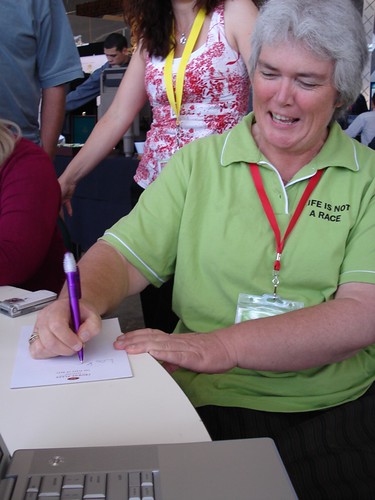
Photo credit: Allanah with a pen? by Fiona Grant

Sunday, November 23, 2008

Lifelong learning

I am in the process of writing a literature review on "informal personal online learning networks". I decided that lifelong learning will be a central idea in this review and began reading 'The concepts and practices of lifelong learning'.

I realised that I had a very narrow view of the concept and there are elements that I have never entertained. Some ideas I am grappling with at the moment are:

  • Lifelong learning can be thought of as elitist. The concept is that the individual will drive their own education and access opportunities but not that the government will provide those opportunities (as opposed to the policy of lifelong education). If this is the case then only those people who can gain access through their economic or social position will have access to quality lifelong learning. This brings up the whole question of equality.
  • Lifelong learning can be linked with social control. If you accept the notion of lifelong learning then people accept they must adapt and change. This clouds out the other issue of questioning the direction of the change. Deleuze says that one of the features of societies of control is the idea of perpetual learning.
  • Lifelong learning is essential in the 21st century because of the changing learning society spurred on by changes in science and technology.
I still see the value in lifelong learning and think that greater emphasis needs to be placed on the equity issue. Maybe if we face this issue then the issue of power and control can be addressed also as people learn to evaluate and question change before adapting it.

This has really made me think about the fact that this concept 'lifelong learning' needs to be understood in detail before being claimed to be of benefit for our students or ourselves. I am a lifelong learner and I embrace the concept more now that I have begun to explore what it means, the inherent pitfalls and the opportunities for making the concept of value for all, not just the select few.

These are my initial musings. I am just starting to explore this issue, I am sure many more ideas will come to light so I reserve the right for this post to be seen as my grappling with ideas not making black and white statements. :)

Friday, November 21, 2008

Engagement of our students

Today I spent some time watching videos put together by Michael Wesch. Many will know his now famous video The Machine is Us/ing Us. He has made a series of other videos about students engagement in school and a fascinating lecture which expands on his simple videos. Below are some of the key messages I pulled out of these videos.

Michael Wesch from Kansas State University put together the video A vision of students today (4:44min) after observing a level of disengagement in tertiary students he wasn't happy with. This video inspired a similar video for junior students A vision of k12 students today (4:09min)

In a presentation at the University of Manitoba entitled A portal to media literacy (1hr) Michael Wesch expanded on the initial video explaining how it came about and discusses the use of digital literacy to enhance student learning.

He asked his students:
Who doesn't like school?
Over half put up their hands.

He asked his students:
Who doesn't like learning?
No one put up their hands.

Michael Wesch also talks about the common statement made by teachers that

Some children are not cut out for school

He then makes the point that School is Learning

Is it fair to say:

Some children are not cut out for learning?


The power of the learning environment is discussed, with the question "What do the walls say about learning?"

He says that the traditional classroom may say:

"To learn is to acquire information
Information is scarce and hard to find
Trust authority for good information
Authorised information is beyond discussion
Obey the authority
Follow along"

This just is not the case for 21st century learning.

What does your learning environment say about learning?

Thursday, November 20, 2008

The power of sharing ideas

I had a good day yesterday. The best part of my job is listening to teachers share their successes and ideas. I spent yesterday at Outram School and every teacher I worked with walked in with something they were proud of to share with me. What a buzz!

I had one teacher who had been exploring the use of glogster to make posters explaining algebraic equations. Another teacher had made her first digital story with PowerPoint on a Mac and then using the easy 'make movie' function to turn it into a Quicktime to post on her blog. The next teacher was buzzing from a workshop she attended at ULearn facilitated by Amanda (heymilly) on 5 frame storytelling. She had started with two frame stories with her 6 year olds and was delighted with their achievements. We discussed the next steps and how digital storytelling can enhance and enable oral language in students and the resounding "That's so exciting" could be heard emanating from the room. Another teacher had made the most remarkable printed storybooks with her juniors where their original artwork had been scanned.

Wow! All this after just one year in the cluster! I remember my first visit to the school where I met with some very uncertain teachers. Uncertain about their ability, uncertain about how useful ICT is for learning, uncertain about the cluster. I am really looking forward to watching these teachers' journey continue over the next two years.

Friday, November 07, 2008

Now for a post about nothing...

I have been reading some photography blogs and one had some tips for photographing pets and I thought I would have a go with my lovely Jessica...

Monday, November 03, 2008

2009 e-Learning teacher fellowships


The 2009 e-Fellowships have been announced and I am very excited that a close friend and colleague, Esmay Sutherland, has been awarded an e-Fellowship for next year! Esmay will have an exciting year working alongside the talented people at CORE Education on a research project incorporating movie making and literacy. Who knows... I may even be able to get her blogging!

I have always said Pine Hill School Leads the Way! and this definitely is the case with effective teaching and learning with ICT. Pine Hill School is a small 3 classroom school and has had two teachers awarded e-Fellowships over the last three years. Not bad for a small school at the bottom of the South Island.

Update: Here is the official press release
Blogged with the Flock Browser

Sunday, November 02, 2008

Saturday, November 01, 2008

Kidz@Conference


Over the last two days in Dunedin we have held our annual Kidz @ Conference. This is the third year this event has been running and we seem to have ironed out a lot of the kinks. One of the aims for this year was to make sure that the students' work made it online, the last two years this has been a bit of a mission but this year I think we cracked it!

The theme for this year was "I have a dream". Students attended four sessions through out the two day conference learning how to use various technologies: I Can Animate, Garage Band, Lego Robotics, Beebots, digital photography, movie making, green screen, Google Sketchup, Scratch and Wikispaces. And making new friends across the various schools attending. The key to the conference is collaboration, communication and technology.

The Kidz @ Conference is a remarkable two day event for those students lucky enough to attend. There are only places for 100 students (year 5 or 6) and teachers can attend with the students to sit in on the sessions as professional development. The buzz of excitement is contagious. On the first day the students arrive and are given their conference packs and a t-shirt. They then file into the lecture theatre at the University of Otago College of Education where the conference is held. One student was heard to exclaim:
Wow! Look at the seats!
Every part of the conference is an event for the students. After rifling through their packs they were entertained by some very cool dudes from the John McGlashan School band .


These young men from the band then spent the day at the conference running sessions called "Jam with the band". Students could learn how to play their instruments and have their jam session recorded. These sessions can be found on the wiki.

The theme of this year's conference was apt. The Kidz @ Conference has been a dream of the organisers for a very long time and was realised in spectacular fashion this year. A big thank you and well done goes to all the session facilitators and conference organisers who come from schools and education institutions around Dunedin and volunteer their time for free to put on this event. It is a privilege to be involved and I look forward to next year's event.

Friday, October 24, 2008

MPG video and sound problem in iMovie

Last night I hit a problem. A colleague is in the last stages of cancer and the staff at her school have made her a tribute in the form of video clips of children and colleagues saying goodbye. I was given all the footage to build into a movie. I was honoured to be asked to help.

I sat down with these clips and started building the movie, however when I imported the MPG clips into iMovie there was no sound. I hadn't come across this problem before so I thought I would post the solution I found for anyone else who comes across the same problem.

Apparently MPG intertwines the audio and video tracks so iMovie can't separate them (there will be a technical way of explaining this I'm sure). I consulted trusty Google and one solution I came across was to use some software to split the MPG into an audio and video track then resync them in iMovie. Oh no! this was going to take forever.

Luckily I came across another solution. I downloaded Mpeg streamclip and the problem was solved. I converted each clip using this software into quicktime movies and had the movie built and burnt to disk in no time at all!

This got me thinking (as it always does) about the joys of problem solving. I was on a high because I had solved this problem, it was a similar feeling to finishing a half marathon! It was made even more special because it was such an important problem to solve for the people involved. Do we rob our students of experiencing the joys of problem solving when we solve their problems for them? Our role as teachers is to guide them in their journey to finding the answers and let them enjoy the feeling of success. It takes a skillful teacher to help someone find their own answers.

Thursday, October 23, 2008

Close up digital photography with kids


I had the privilege yesterday to work with a group of year 4/5/6 students at Ravensbourne School. We were looking at how to take close up photos. The photo above is one of the results of our session taken by Alisha, a year 4 student and I think it is amazing! We talked about how to take a close up using the macro function, we talked about angle and lighting.

I took a group of 10 students and taught them these elements of photography and they then went out and took some photos and shared back with each other. Five students then paired up with a new five students and taught them everything they knew. We did this until everyone in the class had learnt how to use the camera to take quality close up shots. I stood back in wonder as the students did such a good job at teaching each other and the excitement built over every creative shot taken. There was no silliness, no silly photos, just students whose world view had been narrowed! I say narrowed because they began peering around the school yard looking for small things of interest. A great cry went up when it was noted that small green clusters of leaves had small droplets of water inside which glistened in the sun!

It is a privilege to be a part of a child's learning. To share the excitement of new knowledge. To discover a world that went unseen before we, as teachers, opened the door to help students see.

I love my job.

Friday, October 17, 2008

Can kids teach themselves?

I have just watched a thought provoking TED talk, so thought provoking that I had to write this blog post as I sit on my plane flying from Wellington to Dunedin. Sugata Mitra asks the question “Can kids teach themselves?” and went about finding out with a very interesting research project. Concerned about the poor level of education for students in remote areas such as rural India Sugata decided to find out how technology could help. He built ‘hole in the wall’ computers connected to the Internet and placed them in remote, non English speaking areas and then videoed what happened. He found that children very quickly taught themselves how to use these machines to browse for information. Amazingly these children taught themselves how to speak English using the machines to enable them to actually use the machines!

He found that all children could teach themselves with the computer, and this is the vital bit – as long as they were in twos or more. Over 300 children would become computer literate in a 6 month time frame with only one computer. And this was because of the group nature of the learning.

There are many more profound instances in this talk, I urge you to watch and be challenged.

Now I am not seeing this talk as saying we don’t need to teach our kids. One of Sugata's premises was that technology is being rolled out for schools with good kids and good teachers and not making too much of a difference, where it should be rolled out in areas where students are not experiencing a good education, have a lack of teachers, lack of quality education and there the technology makes a marked difference.

However there are important elements in this talk for those of us lucky enough to be in well-developed education systems. There were two major things that stood out for me in my thinking from the results of this research project. The first one was that it affirmed my solid belief in the importance of using computers collaboratively. With all the push for 1 to 1 computing I think we are losing the great benefit of students talking to each other and problem solving together.

The second thought was to do with teachers who are afraid to introduce technology unless they are proficient in it themselves. I have always believed that teachers need to be confident with the technology and be able to know the possibilities but do not need to be the expert. This talk highlights that we can’t hold kids back because of our limitations. My favourite way of introducing new technology to my class is to grab a couple of kids, give them time to explore and play, have them report back to me on what the technology can do and then I introduce it to the rest of the class. I then have ready made experts who can support the students. My job as the expert in learning and teaching is to know how this technology can enhance and extend my students’ learning. If we hit a problem with the technology, then fantastic, problem solving time!

The quality of the sound is a bit low but stick it out, it is worth it.


Blogged with the Flock Browser